What is the best book on bipolar disorder?
What is the best book on bipolar disorder? It depends on how deep you want to go.
If you just want the basics, start small. A single JAMA Patient Page [1] gives a clear, medically grounded overview without drama or jargon. It’s fast, factual, and accurate. That’s a good foundation.
If you want the full picture, there is one book that stands above the rest.
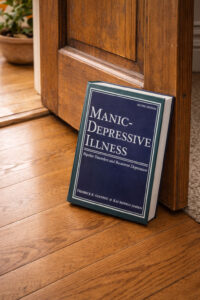
It is not a “read on the couch” book. It’s a 1,260+ page reference text that was published in 2007. Dense. Heavy. Because there have been so many changes in the understanding of the metabolic and genetic drivers of bipolar disorder, it is more useful as an historical reference, not a guide to treatment at this point in time.
The book is Manic-Depressive Illness: Bipolar Disorders and Recurrent Depression, by Frederick K. Goodwin and Kay Redfield Jamison.[2] It is the sort of book that psychologists and psychiatrists have as a reference in their professional libraries. For what it is, it is as gripping as any novel. You’ll find all the heart-break, heroism, and hope for redemption of a good story. But you are probably thinking of something smaller, shorter. So, I’d start with the JAMA Patient Page.
I read parts of an early edition years ago. Much of it was over my head at the time, but even then it changed how I thought about the illness. The sheer size of the book says something important: bipolar disorder is not a mood quirk or a personality type. It’s a complex medical condition with decades of research behind it.
Personally, I think we also have decades of research ahead of us to more fully understand bipolar. I keep this tome as a reminder that great minds are working with dedication to help those of us with this destructive disorder.

Popular “for everyone” books were less helpful to me. Many were so broad that half my coworkers could have qualified as bipolar. When definitions stretch that far, the term stops meaning anything useful. Experts are still refining where illness ends and normal human variation begins. That uncertainty matters.
Memoirs can help some readers, but many felt sensational or unrelatable to me. I’m not a headline story. I’m more like a dandelion. Yellow on good days. Gray and scattered on bad ones.
One personal account exception was actress Patty Duke’s A Brilliant Madness. Her description of functioning professionally while carrying private chaos rang true. I understood that. Showing up. Doing the job. No one knowing how hard it is behind the curtain. How disconcerting it is for family and other people around you.
Newer Theories of Bipolar and Directions in Treatment
More recently, psychiatrist Chris Palmer, MD has proposed that many mood disorders may involve impaired brain energy metabolism. His clinical work with ketogenic diets and mitochondrial function offers a different lens on bipolar disorder—one that is grounded in biology rather than willpower or personality. (Go to Field Note on restoring metabolism)
So, my practical recommendations:
Start with the JAMA summary.
If you want historical depth, get the Goodwin & Jamison reference.
Use memoirs only if they help you feel less alone.
References
[1] JAMA Patient Page – Bipolar Disorder. JAMA. (search: “JAMA Patient Page Bipolar Disorder PDF”; they update periodically).
[2] Goodwin FK, Jamison KR. Manic-Depressive Illness: Bipolar Disorders and Recurrent Depression, 2nd ed. Oxford University Press, 2007. (I bought mine on Amazon)
[3] Duke P, Hochman G. A Brilliant Madness: Living with Manic Depressive Illness. Bantam, 1992.